
For the women who were “fine in school” — and are drowning now
You’re not lazy, and you never were.
Adult ADHD in women, finally explained like a human — a 14-day, plain-English guide with the tracker, childhood-history worksheet, and assessment playbook that turn “what is wrong with me” into organized evidence a professional can actually use.
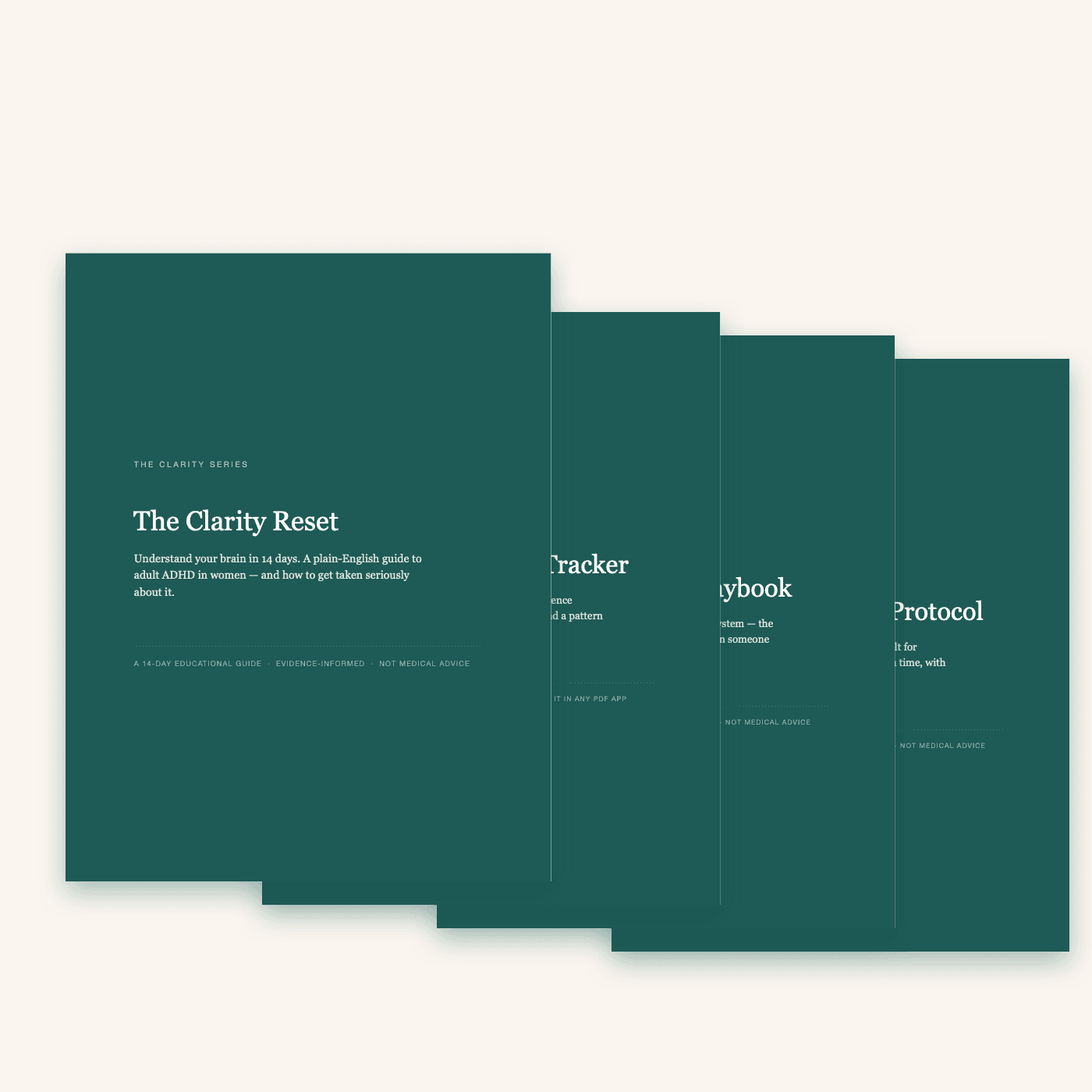
Exactly what you get
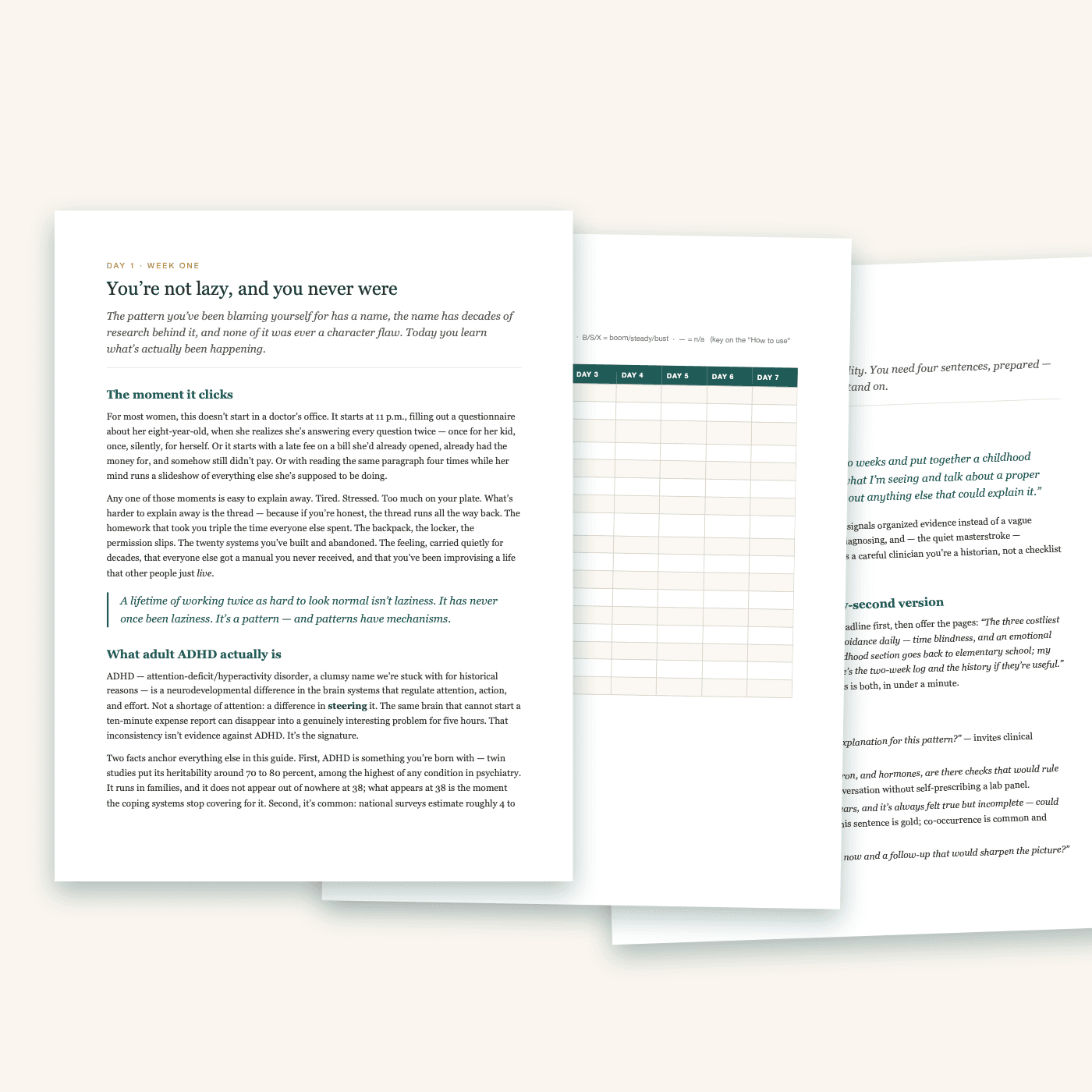
The Core Guide51 pages · 14 daily chapters · 10 minutes a day
- Week One — the machinery: executive function in plain English, why the girls got missed, the masking, why it all surfaced now, the estrogen–dopamine connection, the emotional side honestly labeled
- Week Two — your patterns decoded: time blindness, boom-bust, the ADHD tax — then the lookalike conditions, how assessment actually works, and the options landscape without hype
- Evidence honestly tiered: where research is strong it says so; where it’s young or informal — the hormone connection, “RSD” — it says that too, plainly
- Grounded in sources you can name out loud: peer-reviewed research, CDC data, CHADD resources, the DSM-5-TR criteria described neutrally
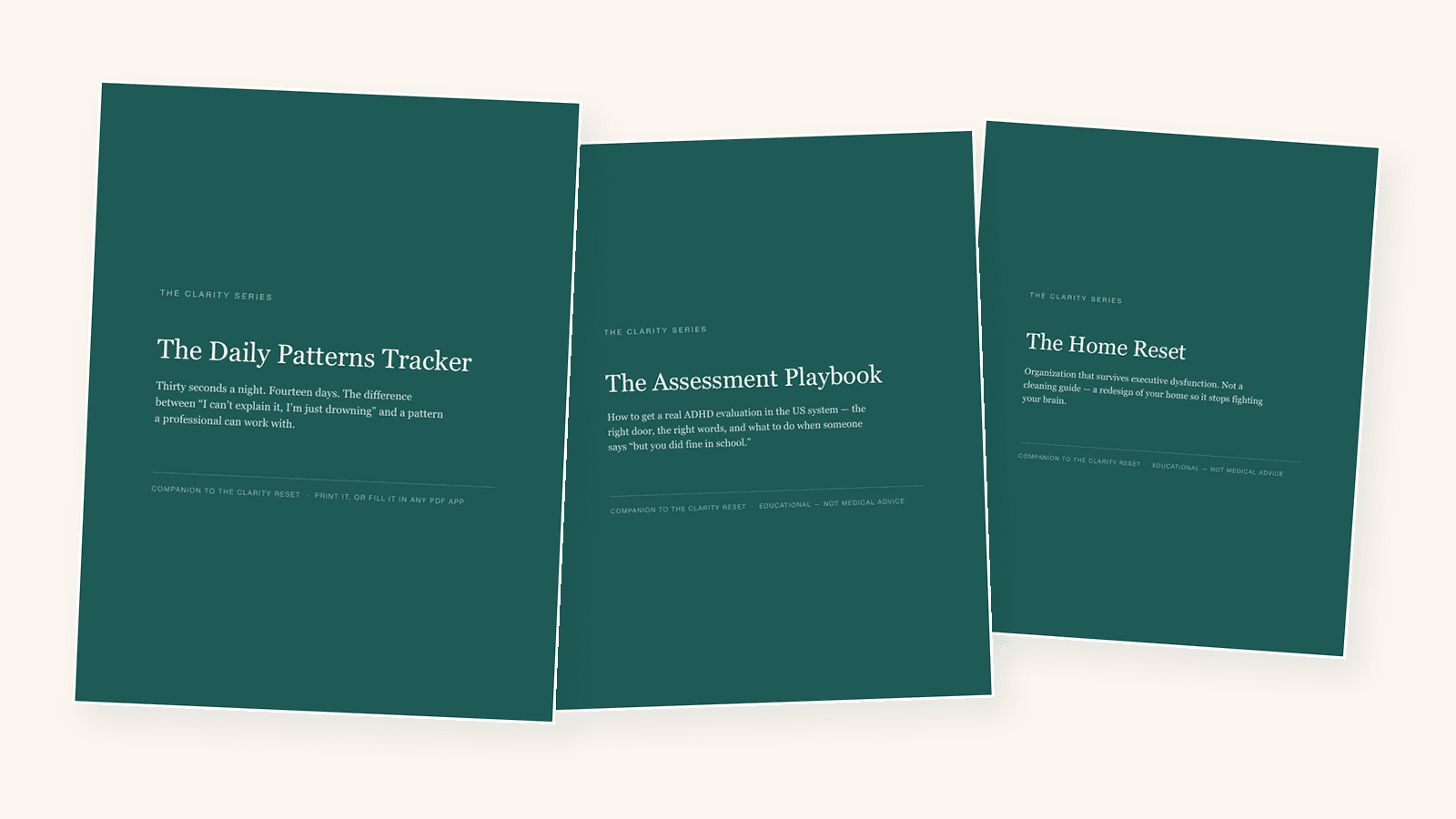
The Daily Patterns Tracker12 pages · 30 seconds a night · childhood-history worksheet included
- Two weeks of tracked focus, time-sense, overwhelm, and cycle data
- The three-page childhood-history worksheet — assessors ask about childhood, and almost nobody arrives with it done
- The difference between “I’ve always struggled” and showing organized evidence
The Assessment Playbook5 question banks · scripts by situation
- Which door to choose: family doctor, psychiatrist, psychologist, telehealth — and how to spot the checklist mills
- The exact opening sentence, and calm scripts for the “but you did fine in school” moment
- The costs-and-insurance reality talk, without sugarcoating
The Daily Systems Protocolone-variable-a-week experiments · no streaks, ever
- Externalization, body doubling, task-ignition tools, boom-bust engineering
- Systems designed for executive dysfunction instead of against it — scored with your own tracker
Four PDFs (five with “The Home Reset”) · instant download · yours forever · read Day 1 tonight.
A private adult ADHD assessment in the US can run $1,500+. This is the preparation layer that makes that money — and that appointment — count.
- The Core Guide — 14 days that turn “what is wrong with me” into a pattern with a name and a mechanism
- The Daily Patterns Tracker — two weeks of organized evidence a professional can actually use, plus the childhood-history worksheet assessors ask for
- The Assessment Playbook — the exact scripts and question banks for the “you did fine in school” moment
- The Daily Systems Protocol — externalization systems designed for the brain you actually have
4 PDFs · 51-page core guide · 12-page tracker · 5 question banks · 14 days
30-day money-back guarantee — full refund, keep the tracker.
Secure checkout by Shopify · Published by The Reset Series · Files delivered to your email the moment payment clears
It rarely starts in a doctor’s office.
It starts at 11 p.m., filling out a questionnaire about your kid — and answering every question twice, once silently for yourself. Or with a late fee on a bill you’d already opened and had the money for. Or with twelve tabs open in your brain and none of them loading, while the important task sits untouched for the fourth day in a row.
And because you did fine in school, because you hold it together at work, every explanation lands on character. Lazy. Scattered. Not trying hard enough. Until the quiet 2 a.m. search: am I lazy, or is something actually wrong?
Here’s what nobody put on a poster: there is a well-researched explanation for this exact pattern in adult women — a generation of inattentive girls the referral system skipped, who grew up compensating brilliantly, until midlife load broke the coping systems. National surveys estimate roughly 4–6% of US adults have ADHD, and women in their 30s and 40s are the fastest-growing group finally getting answers.
You’re not broken. You’ve been running an invisible marathon without the manual — and understanding the pattern properly is a fourteen-day project, not a life sentence.
Sound familiar?
- The important task circled for days while you do forty things around it
- “I paid the late fee. Again. On the bill I’d already opened.”
- Three unstoppable days, then a crash you punish yourself for
- A 2 p.m. appointment that somehow cancels the whole morning
- Feelings that arrive huge; a two-second glance replayed for three days
- Twenty planners and systems, built and abandoned
- The lifelong feeling that everyone else got a manual you never received
To be clear about what this is: recognizing yourself in a list is a reason to learn more — it is not a diagnosis, and this guide will never pretend to be one. Only a real assessment by a qualified professional can answer the question. What these fourteen days do is make you the best-prepared person in that room.
Grounded in
Peer-reviewed research · CDC data · CHADD resources · the DSM-5-TR criteria, described neutrally
The 14-day map
Week One — what’s actually happening
- You’re not lazy, and you never were
- Executive function, explained like a human
- Why the girls got missed
- The mask: a lifetime of compensating
- Why it all surfaced now
- Your hormones are in this too
- The feelings are part of it
Week Two — your patterns, decoded — and your plan
- Time blindness and the overwhelm cycle
- Boom, bust, repeat
- The ADHD tax
- The lookalikes and the companions
- How assessment actually works
- The options landscape
- Your clarity plan
Why this works when the internet didn’t
The internet gives you fragments. One video says ADHD, one article says anxiety, a quiz says “probably!”, and a comment section sells you a supplement. This gives you the connected picture, in order, with the evidence honestly tiered — from sources you can cite in a clinician’s office.
It arms you, not just informs you. The tracker, the childhood-history worksheet, and the playbook exist because self-recognition without evidence still gets dismissed in a fifteen-minute appointment. Two weeks of organized data plus a documented childhood changes the meeting.
It’s honest about what it is. This is education. It contains no self-quiz scored to tell you what you want to hear, it doesn’t diagnose, and it never pretends a PDF can do an assessor’s job. That honesty is exactly what makes the material usable in a real appointment.
Who it’s for: you’re a woman roughly 30–55, the pattern fits uncomfortably well, and you want to actually understand it — and walk into any future assessment prepared instead of hoping. Not for you if you’re looking for a diagnosis, a treatment plan, or medical advice; those belong to a qualified professional — and this system is built to make that conversation finally go somewhere.
Everything in the bundle
A private adult ADHD assessment in the US can run $1,500+. This is the preparation layer that makes that money — and that appointment — count.
- The Core Guide — 14 days that turn “what is wrong with me” into a pattern with a name and a mechanism
- The Daily Patterns Tracker — two weeks of organized evidence a professional can actually use, plus the childhood-history worksheet assessors ask for
- The Assessment Playbook — the exact scripts and question banks for the “you did fine in school” moment
- The Daily Systems Protocol — externalization systems designed for the brain you actually have
4 PDFs · 51-page core guide · 12-page tracker · 5 question banks · 14 days
30-day money-back guarantee — full refund, keep the tracker.
Secure checkout by Shopify · Published by The Reset Series · Files delivered to your email the moment payment clears
Not ready to buy? Start free.
The free sample — Day 1 of the guide plus a week of the Daily Patterns Tracker — sent to your email. No card, no strings.
Checkout collects only your email — $0.00, no card fields.
Questions, answered honestly
Can this tell me whether I have ADHD?
No — and you should distrust anything that claims it can. No PDF, quiz, or video can diagnose ADHD; only a qualified professional can, through a real evaluation. This system explains the pattern, helps you document yours, and prepares you for that professional conversation.
Is this medical or psychological advice?
No — deliberately. The Clarity Reset is educational. It explains what the research says and how to have a productive conversation with a qualified professional. It never diagnoses, never recommends treatments, and never replaces your clinician.
What if it turns out not to be ADHD at all?
Then the system still did its job: the lookalike chapter exists because thyroid issues, sleep problems, iron deficiency, and perimenopause can wear the same costume, and the tracker data helps a clinician find whatever it actually is.
What exactly do I get, and how?
Four PDFs — the 14-day core guide, the Daily Patterns Tracker with a childhood-history worksheet, the Assessment Playbook, and the Daily Systems Protocol — delivered instantly after checkout. No login, no app, no subscription.
Refunds?
Yes — a 30-day full money-back guarantee, no hoops: reply to the delivery email within 30 days of purchase.